We acknowledge all First Peoples of this land and celebrate their enduring connections to Country, knowledge and stories. We pay our respects to Elders and Ancestors who watch over us and guide Aboriginal and Torres Strait Islander community.
We acknowledge all First Peoples of this land and celebrate their enduring connections to Country, knowledge and stories. We pay our respects to Elders and Ancestors who watch over us and guide Aboriginal and Torres Strait Islander community.

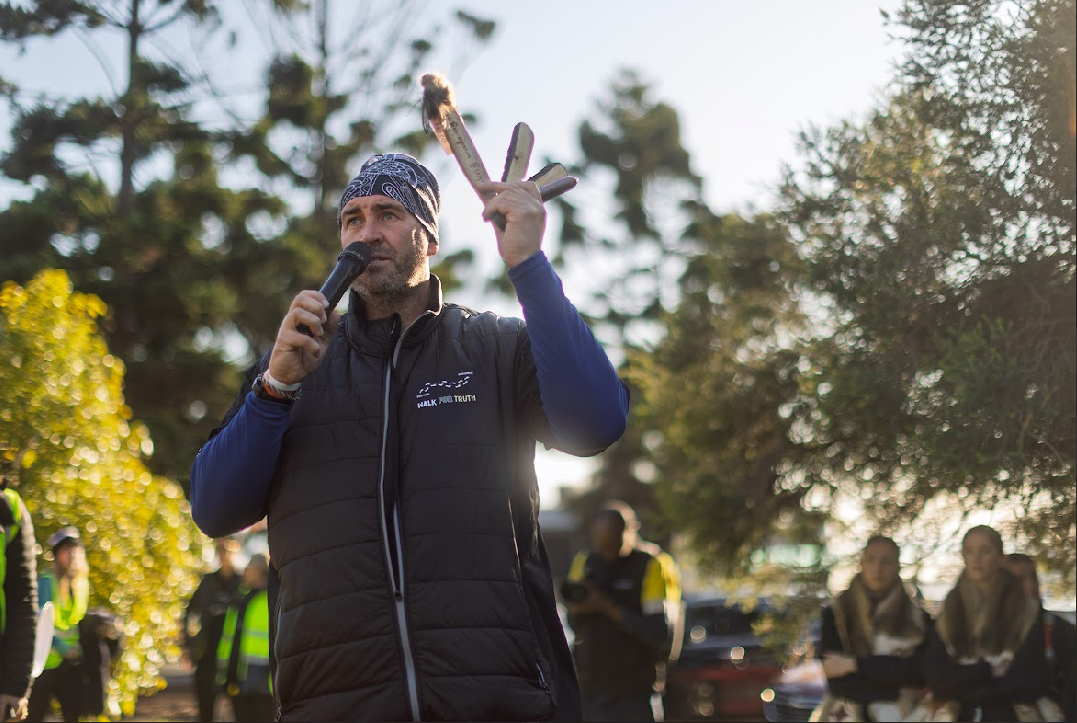
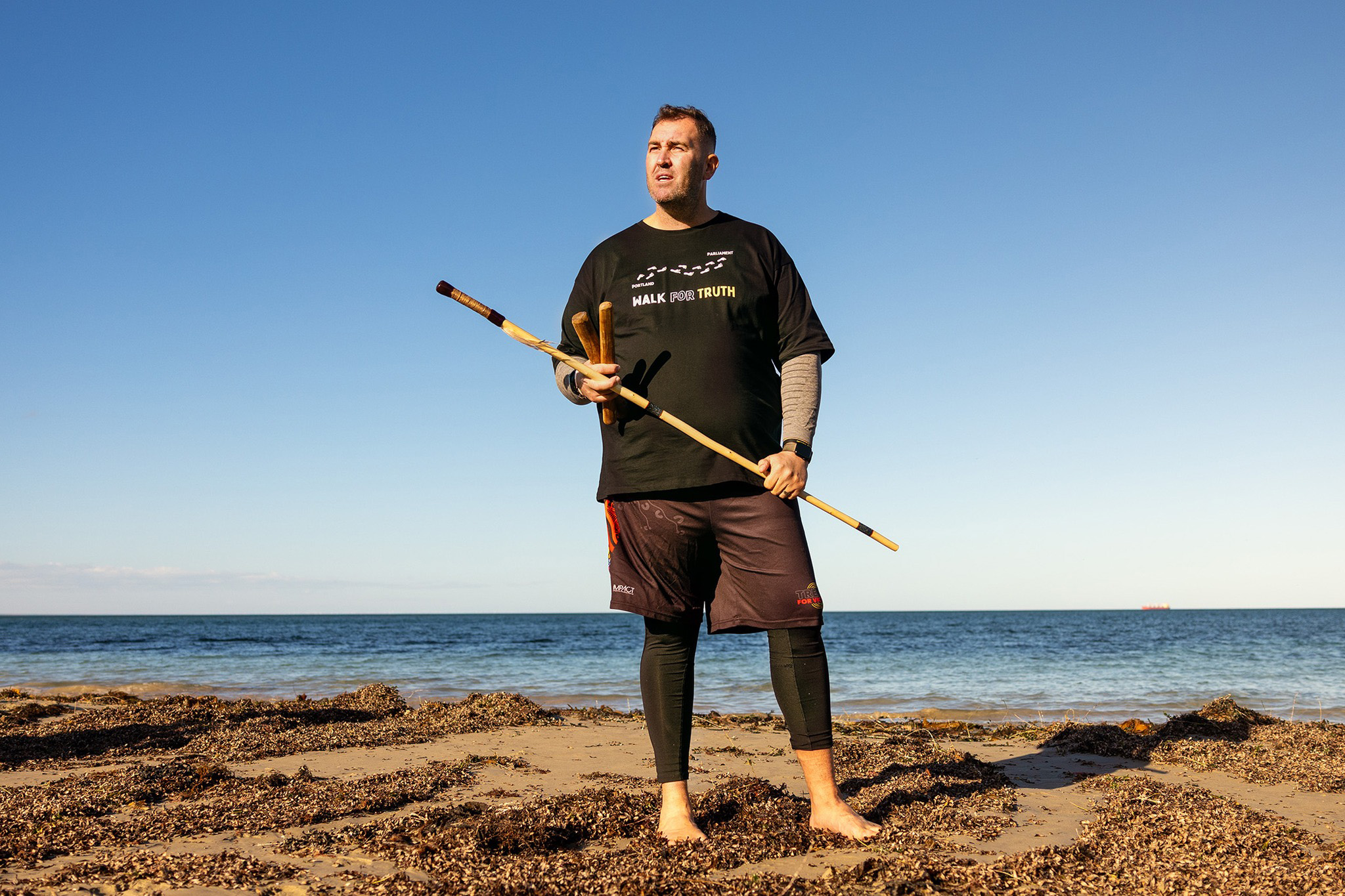
Travis Lovett shares reflections on the importance of truth-telling and why there will be a Walk For Truth to Canberra.
Being willing to listen to the truth, to sit with it, even when it is uncomfortable and then to act on it is essential if we are serious about healing and unity in this country.
This is why we Walk For Truth and why we need national truth-telling.
As a society, we often reflect on the challenges we face today – racism, bigotry, violence against women, genocide – as though they are new or disconnected from our past. But when we look honestly at the history of this nation, the truth is undeniable. These harms are not anomalies. They are rooted in the very foundations upon which this country was built.
Australia was established through invasion and violent dispossession – through the murder of people based on race, enforced segregation, the forced removal of children and exclusionary policies like the White Australia Policy, designed to control, exclude and erase.
These were not isolated mistakes of history, but systems and laws deliberately created and upheld. When a nation is built on violence, exclusion and inequality, those values do not simply disappear. They embed themselves into institutions, attitudes and systems unless they are confronted and dismantled. This is why we continue to face the same patterns of harm today.
It is not a failure of individuals. It is the consequence of a country that has never fully dealt with its truth.
Six months before the first Treaty was struck in Victoria, we began on a journey. The Walk For Truth was an act of collective truth-telling and unity.
The 513km journey from Portland, where colonisation first began in Victoria, to Parliament House in Melbourne, took us through hundreds of communities, sharing truths of our past and the persistent injustices that continue to shape lives today. Along that walk, we spoke with people from all walks of life.
What became clear again and again was that the community is ready – ready to listen, ready to learn and ready for truth.

That’s why, once Treaty was in place in Victoria, the decision was made to continue the walk. This time to Canberra, to the nation’s doorstep, so we could bring the whole nation on the journey toward truth, justice and healing.
On the Walk For Truth in Victoria, we heard some of the most confronting truths of this nation. Truths like those of Killarney Beach, where men, women and children were buried in the sand with only their heads above ground, used as objects, as sport, as entertainment. These are horrific truths and they are Australian truths. Healing cannot occur while lived experiences like these remain hidden, denied or minimised.
But truth-telling is not only about exposing violence. It is also about honouring resistance, strength and survival.
We heard the truths of the fighting Gunditjmara. People who organised, defended their Country and resisted invasion with extraordinary courage. In any other context, this would be celebrated as a David and Goliath story, as the ultimate “Aussie battler” narrative. Yet when that resistance belongs to First Peoples, it is too often ignored or erased.
We must ask ourselves why.
There are also truths of relationship, respect and humanity that show us what was and still is possible. Truths like that of James Dawson and his daughter Isabella, and their relationship with Wombeetch Puyuun, also known as Camperdown George.
Dawson stood out among colonists for showing genuine respect for Aboriginal people. Isabella, born in 1842, grew up alongside First Nations children, became fluent in their languages and carried that respect forward. When the Dawson family moved to Camperdown in 1868, James met Wombeetch and the two formed a deep and lasting friendship, which was far from the norm of the time.
These lived experiences matter because they show us another way. A way grounded in respect, listening and truth.
The truths shared by Aboriginal and Torres Strait Islander Peoples about colonisation make one thing unmistakably clear: January 26 is a day of pain, not pride. It marks the beginning of invasion, dispossession and violence, alongside generations of resistance, survival and enduring strength. Australia remains the only country that marks its national day on the anniversary of invasion.
As Narelda Jacobs has powerfully said, “it is like dancing on someone’s grave”. This is the burden First Peoples are asked to carry every year.
National Truth-Telling creates the space for this country to confront its history honestly. To listen to First Peoples, to understand how the past lives on in the present and to acknowledge the urgent need for systemic and structural transformation across our institutions, including education. Truth-telling calls each of us into leadership and responsibility for the future we are shaping together.
Truth is not divisive. It is the foundation of strong, respectful and honest relationships. This is why truth-telling is essential to this nation’s future.
The Walk For Truth brings people together to walk side by side, across Country and through communities, carrying the truth of this nation – the painful, the confronting, the powerful and the hopeful.
Truth-telling is not about blame or erasure. It is about responsibility, respect for Country, respect for people, respect for past generations and responsibility to future generations. It is about repair, healing and moving forward with care for one another.
Changing the national day to a long weekend that everyone can celebrate is one step toward a future grounded in truth. As a community, we must ask ourselves: how can healing occur when people are told to “just get over it”? That mindset reveals how deeply the true history of this country and its ongoing impacts remain unknown.
A nation built on truth is one that can heal, unite and move forward with integrity and pride. That journey begins when we choose to walk together.
And that walk begins with the National Walk For Truth.
Show your support and sign the open letter to the Prime Minister.

We are a First Nations not-for-profit that exists to centre First Nations people, Country and truth-telling. We acknowledge all First Peoples of this land and celebrate their enduring connections to Country, knowledge and stories. We pay our respects to Elders and Ancestors who watch over us and guide Aboriginal and Torres Strait Islander community.